Mes amis, on this day of Prairial, we celebrate the strawberry as the French Revolutionaries would surely have wanted – with ice cream. In looking through past posts, I was sure that I had written about the etymology of “strawberry” before, but apparently not! All my strawberry research so far has been off the clock. No longer. Last summer, we planted strawberry plants for the first time in our garden and wondered about the origin of the word. Turns out, it is up for debate. A lovely article by Anatoly Liberman from the Oxford University Press blog details many theories.
The double trouble with strawberry is that no other European language has a similar name (one late occurrence in Swedish is of unknown provenance) and that, on the face of it, straw– makes little sense in it. The word goes back to Old English, and there must have been a serious reason for coining it or for changing the traditional denomination (that is, “earth-berry,” which did turn up at that time but, judging by the extant texts, was known very little). One thing is clear: the Germanic invaders of Great Britain did not bring the word strawberry to their new homeland from the continent.
Here are some of the options:
- The “straw” is derived from “strew,” which describes how the berries send out runners in a mess of different directions. So, perhaps at one time, they were “strewberries.” Liberman rejects this interpretation as it would have been unlikely the first part of the word would have been a verb.
- When cultivated, gardeners usually use straw for mulching the plants during the winter. Liberman rejects this because before strawberries were cultivated, they were popularly harvested in the wild.
- The “seeds” of the berry could, perhaps, look like straw. This is the etymology favored by the OED, according to Liberman.
- The tendrils that connect the new runner daughter plants to the mother plant could look like thin straws.
- Perhaps a derivation of “strayberry” – describing the wandering nature of the runners.
- Finally, a puzzler (to me) – a corruption of the Norwegian word for the berry, smultron.
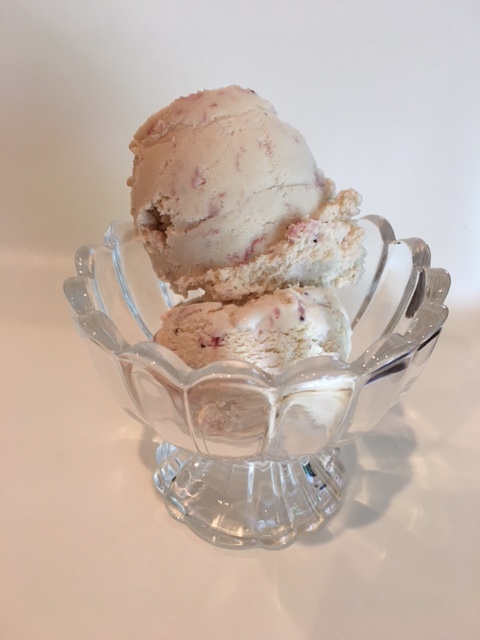
As there are options for the origin of the berry, so are there options for recipes to make on this hallowed day. I combined two ice cream recipes – Jenni’s Splendid Ice Creams idea for roasting the strawberries and David Lebovitz‘s vanilla ice cream base.
Roasted Strawberry Ice Cream
1 pint of strawberries
1 cup whole milk
3/4 cup sugar
2 cups heavy cream
pinch of salt
6 large egg yolks
3/4 tsp of vanilla extract
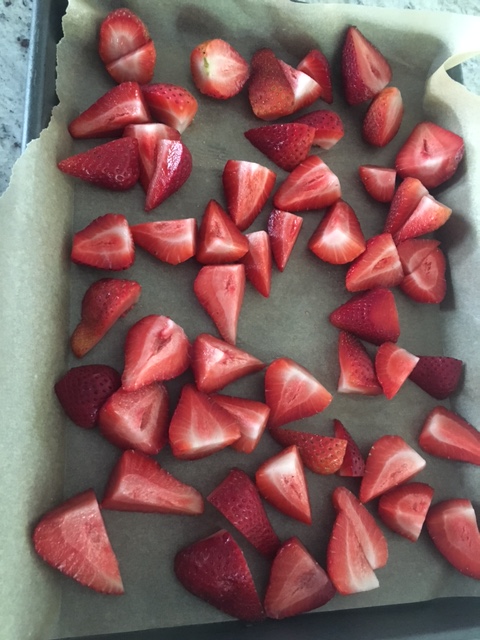
First, clean the strawberries and cut into quarters. Line a baking sheet with parchment and cook at 350 for 10 – 15 minutes. Let cool while you make the ice cream base. Warm the milk, 1 cup of cream and the sugar in a medium pan. In a bowl, pour the remaining cup of cream and place a strainer on top of the bowl. Separate the eggs and slowly add some of the hot milk mixture to the eggs to temper. Pour the eggs into the milk mixture and cook while whisking constantly. When the mixture is thickened, pour into the bowl through the strainer and add the reserved strawberries. Cool overnight and then freeze in your ice cream maker the next morning. Enjoy!
 Eat the revolution